
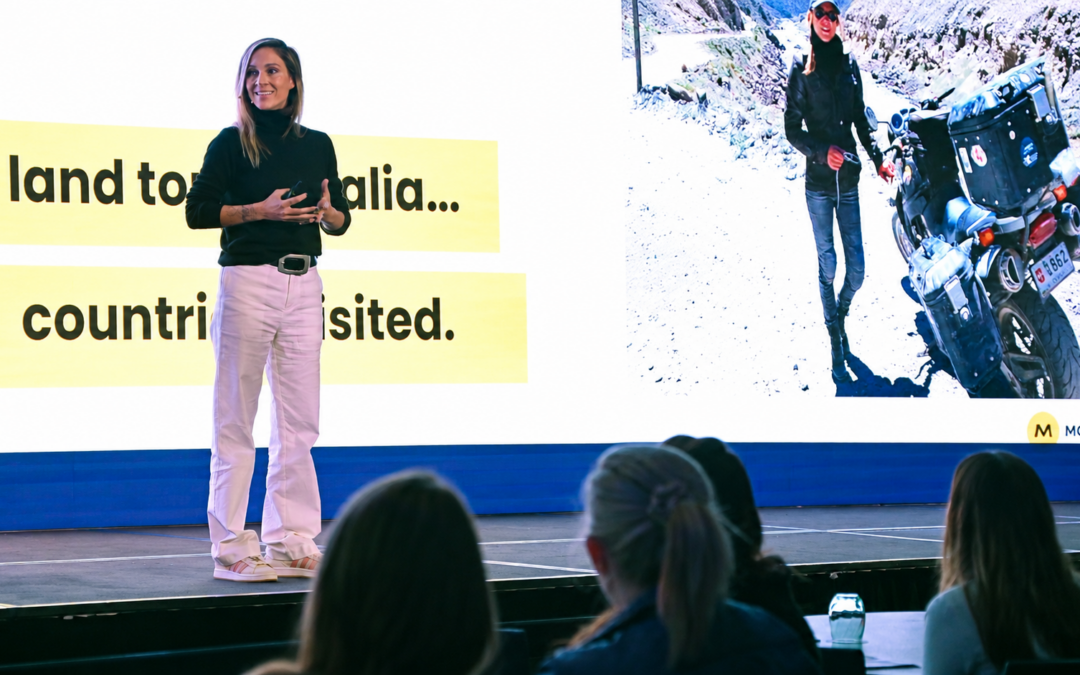
On Tuesday I had the honour of running a workshop for a brilliant group of business owners on the topic of the Human Advantage in the Age of AI. How to ignite curiosity, invite courage and inspire connection.
There were so many insights and beautiful discussions and one of them has stayed with me all week.
Assumptions.
Our brains are gap-filling machines. Neuroscience tells us we are wired to complete incomplete pictures. It’s a survival mechanism that served us well on the savannah. See a shape in the bushes, assume lion, run. Don’t wait for confirmation or you might not get to read the rest of this article!
But we’re not on the savannah anymore. And that same instinct, the one that fills uncertainty with story can get us into ‘trouble’.
We often populate the unknown and make things up to fill the space. And then, we act on what we made up as if it were fact.
I fell into the assumption trap myself recently with a dear friend. Gaps appeared, we both made assumptions instead of staying curious, asking questions and listening intently. And assumptions led to what they often lead to: misunderstanding, instability, and a fracture in trust that takes far more effort to repair than a single curious question would have.
The lesson: Assume less. Wonder more.
The most expensive assumptions in history
Assumptions aren’t just personal. Some of the most catastrophic moments in business history came down to exactly this; someone, somewhere, stopped being curious and started being certain.
Blockbuster assumed people wanted to leave the house to rent a movie. Netflix assumed they didn’t. In 2000, Blockbuster had the chance to buy Netflix for $50 million. They passed. Within a decade, they were gone.
Kodak invented the digital camera in 1975, then shelved it because they assumed it would cannibalise their film business. The camera didn’t cannibalise them, their assumption did. The answer was literally in their hands and they talked themselves out of it.
Nokia had 40% of the global mobile market and assumed smartphones were a passing trend. That hardware was the product. Apple assumed the experience was the product. We know how that ended.
Every major record label passed on the Beatles in 1962. Decca told their manager: “guitar groups are on the way out.” One of the most expensive assumptions in the history of music.
It’s not what happens to you
Epictetus said it two thousand years ago: “It’s not what happens to you, but how you react to it that matters.” Somewhere between stimulus and reaction is a tiny, precious gap, the gap where a question could live, if we let it.
We rush to fill it, because uncertainty is uncomfortable, not knowing feels like weakness and asking feels vulnerable.
So we assume. We construct a reality that confirms what we already believe, that lets us feel in control. And then we defend that construction rather than staying curious.
The future belongs to the curious
Curiosity comes from the Latin cura, to care, to pay close attention to something.
According to research, children ask around 70 questions a day. Adults ask about 20. Somewhere between childhood and adulthood we learn that having the answer is valued more than asking the question. That certainty is strength and curiosity is weakness.
In the age of AI, the machines will do the knowing. They will retrieve, synthesise, optimise and execute faster than any human ever could. What we humans can do better than any algorithm can is to wonder. To question the question. To ask whether the problem we’re solving is even the right problem.
And here’s the thing about tools like ChatGPT, right now they will often validate whatever you put in, clever or not. Which means if you stop wondering, the dumb gets dumber (a topic for another day!).
The organisations that will thrive in the next decade are not the ones with the best technology. They are the ones with the most curious humans sitting alongside the best technology. The ones who built cultures where a question is more valued than an answer. AI replaces your answers, not your curiosity.
Where in your life or business do you make assumptions? Ask your team members that same question and see what they come up with?
Assume less. Wonder more. The future belongs to the wonderers.